
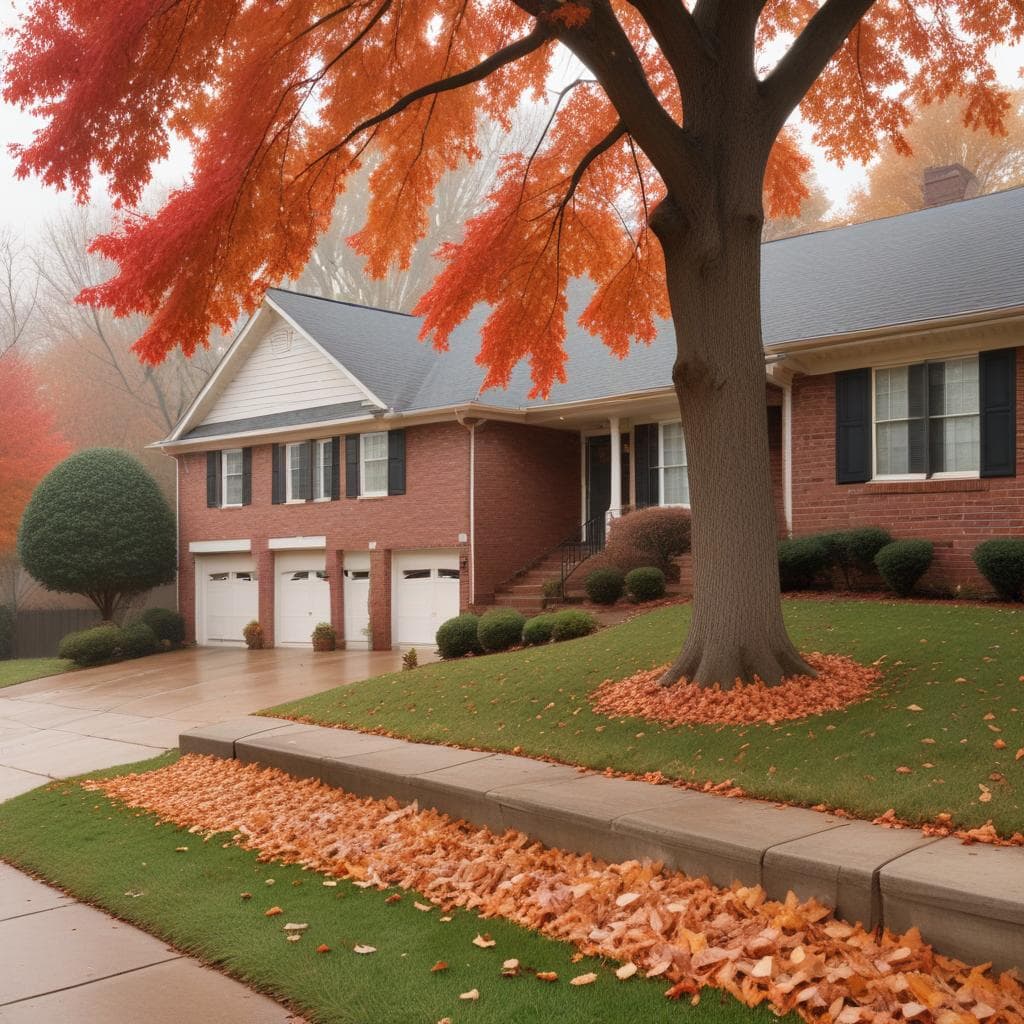
Image: Image generated with Freepik AI
Seller tips
Leaves, Gutters and Drainage: A Late-Fall Checklist for Nashville Sellers
The AmeriKey Team ·
Fallen leaves are the last big yard job of the year in Davidson County, and for anyone listing a home this fall they matter more than curb appeal. Leaves that pile up in gutters, ditches and storm inlets change how water moves around a house, and buyers' inspectors look closely at drainage. Tennessee's seller disclosure form also asks about it directly. Here is a practical late-fall plan for Nashville sellers, built on Metro's own rules and schedules.
Find your brush and leaf pickup date first
The Nashville Department of Transportation and Multimodal Infrastructure (NDOT) collects brush and yard waste from single-family homes in Metro's Urban and General Services Districts four times a year, on a rotation across 12 routes. NDOT's 2026–2027 Brush Collection Schedule lists these fall and early-winter start dates:
| Area | Fall/winter 2026 start date |
|---|---|
| Area 8 | October 6, 2026 |
| Area 9 | October 12, 2026 |
| Area 10 | October 22, 2026 |
| Area 11 | October 28, 2026 |
| Area 12 | November 3, 2026 |
| Area 1 | November 10, 2026 |
| Area 2 | November 18, 2026 |
| Area 3 | December 7, 2026 |
| Area 4 | December 11, 2026 |
| Area 5 | December 18, 2026 |
| Area 6 | December 29, 2026 |
| Area 7 | January 5, 2027 |
These are start dates. NDOT says crews normally need one to three weeks to finish a route, and your materials need to be out before your area's start date. To find your area and date, enter your address in the Nashville Waste Wizard or the Nashville Waste and Recycling app, where brush collection shows as a yellow dot on the calendar.
Two caveats from NDOT's Brush and Leaf Collection page. Metro does not collect brush on private streets. It also does not serve satellite cities such as Forest Hills, Berry Hill and Belle Meade, whose residents should check with their own city. If you're in Area 11 or Area 12, your pickup is this week or next. If your next pickup is in December or January and you're listing sooner, plan to haul the debris away yourself.
Bag and stack it the way Metro will take it
NDOT's guidelines are specific, and a pile that doesn't follow them can sit at the curb through your listing photos:
- Leaves and grass clippings go in biodegradable paper bags only. Plastic bags are not accepted.
- Yard waste is banned from trash collection. Brush, leaves and grass clippings cannot go in your trash cart or a dumpster.
- Size limits apply. Limbs can be up to 4 inches in diameter and 12 feet long. Stumps can be up to 8 inches in diameter, with no dirt or root balls. Bamboo over 8 feet long is not accepted.
- Keep piles reachable. Collection is done by a knuckle-boom truck with only a driver aboard. Piles have to be close enough to the curb or roadway for the arm to reach, and kept clear of mailboxes, trees, fences, utility poles and guardrails.
- Keep it clean. Lumber, household trash and other debris do not belong in a brush pile.
If you hire a landscaper for a pre-listing cleanup, read the contract closely. Under Metro Code 10.20.085, as noted on NDOT's page, brush and yard waste from commercial tree and landscaping services must be disposed of by the company, not left for Metro collection. Make sure hauling is included in the price.
If you can't wait for your route, NDOT lists two drop-off sites managed by Living Earth, at 1511 Elm Hill Pike and 6401 Centennial Boulevard. Davidson County residents can drop off brush and yard waste there for free, though trailers are charged a fee. Hours vary through the year, so call Living Earth at 615-730-7238 before you go.
Keep leaves out of streets, ditches and storm drains
Blowing leaves to the curb is the easy fix, and Metro prohibits it. NDOT's guidelines say not to blow or sweep leaves, grass clippings or other yard debris onto streets, sidewalks or bike lanes. They also say not to place yard waste in medians, ditches, or anywhere it can wash into a storm sewer, catch basin or stream. Putting yard waste in a waterway is a violation of Metro Code Title 15, Chapter 64.
There's a practical reason, too. Metro Water Services says its public stormwater system includes 71,000 inlets, 15,000 outfalls and 1,300 miles of culvert, and is designed to handle a normal rain. A street inlet clogged with leaves sends water somewhere else, and on a sloped Nashville lot that can mean your driveway or crawl space.
Know which drainage problems are yours
Before listing, it helps to know who fixes what. Metro Water Services' Stormwater Maintenance page says the department handles:
- Flooding on the public roadway
- Clogged storm drains
- Roadside ditches and driveway pipes
- Drains under the roadway
- Fallen trees blocking the flow of draining water
- Severe erosion threatening public utilities or the public roadway
The property owner is responsible for problems Metro does not manage. These include stormwater running from one private property onto another, weeds and vegetation in ditches, mowing ditches, underground springs or groundwater, and flooding caused by being in or near a floodplain.
To report a clogged public storm drain or a new drainage concern, call Metro Water Services at 615-862-4600 and choose option 4, or use the department's online stormwater concern form. To report dumping into a storm drain, call 615-880-2420, Monday through Friday from 7:00 a.m. to 3:30 p.m.
For your own lot, Metro Water Services recommends:
- Pointing downspouts away from pavement and toward ground where water can soak in
- Keeping ditches and culverts on your property clear of trash and debris
- Using a sump pump where a basement or crawl space is prone to water
A downspout that empties against the foundation or across the driveway is easy to spot during a showing, and usually cheap to fix before one.
Check for a stormwater control measure on newer and infill lots
Many newer Nashville homes, especially infill builds, sit on lots with a stormwater control measure (SCM). Examples include a bioretention area, a grassy swale or a detention pond. Metro Water Services says property owners are responsible for inspecting and maintaining SCMs on their property.
If the grading permit was issued in 2008 or later, the owner must file an annual inspection and maintenance report, due by July 1. The grading permit year is the first four digits of the SCM Project ID. You can use the Metro Planning Parcel Viewer to see whether your parcel has an SCM. It shows the grading permit, location and type, and sometimes maintenance information.
Metro notes that newly installed SCMs may not appear on the Parcel Viewer yet, and Water Quality Buffers aren't mapped there at all. At least one permanent sign is required at each type of SCM on a parcel, so future owners know it's there and don't alter or remove it.
For a seller, this is worth sorting out before a buyer's inspector or attorney asks. A rain garden full of leaves, missing signage or an unfiled report is a better conversation to have now than during a repair negotiation.
Answer the disclosure form accurately
The Tennessee Residential Property Condition Disclosure, the statutory form set out in Tenn. Code Ann. § 66-5-210, asks sellers several drainage-related questions:
- Rain gutters are listed among the property's included items, and the form asks whether any listed item is not in operating condition.
- Item 3 asks about authorized changes in roads, drainage or utilities affecting the property or next to it.
- Item 10 asks directly about "flooding, drainage or grading problems."
- Items 11 and 12 ask whether flood insurance is required and about any damage from floods or landslides.
The form tells sellers to answer each question to the best of their knowledge and to label estimates as estimates. It also states that the disclosure is not a warranty or a substitute for professional inspections, and that the sales agreement supersedes the form on repair obligations.
Cleaning gutters doesn't change a truthful answer. It does make it easier to give one: you'll know whether water pools by the back steps after a heavy rain, and a buyer's inspector will see a well-kept house instead of overflowing gutters.
A late-fall checklist for Nashville sellers
- Look up your NDOT brush area and start date in the Nashville Waste Wizard.
- Bag leaves in paper yard-waste bags and set them out before your start date.
- Keep leaves and debris out of the street, the gutter line, ditches and storm inlets.
- Clean roof gutters and check that each downspout carries water away from the house.
- Clear private ditches and driveway culverts. Report clogged public drains to Metro Water Services at 615-862-4600, option 4.
- Check the Parcel Viewer for a stormwater control measure, then confirm its maintenance, signage and annual report status.
- Take note of any pooling or erosion after the next heavy rain, and answer the disclosure form's drainage questions accurately.
If you're planning to list in Nashville this fall or early next year, The AmeriKey Team can help you sort out pre-listing repairs, vendor scheduling and disclosure questions before your home goes live.
Sources
- Nashville Department of Transportation and Multimodal Infrastructure (NDOT), Brush and Leaf Collection in Davidson County, nashville.gov
- NDOT, 2026–2027 Brush Collection Schedule (flyer), nashville.gov
- Metro Water Services, Stormwater Maintenance and Request Emergency Service, nashville.gov
- Metro Water Services, Stormwater Control Measures, nashville.gov
- Tennessee Residential Property Condition Disclosure, Tenn. Code Ann. § 66-5-210
Sources
- https://www.nashville.gov/departments/transportation/right-way-maintenance/brush-and-yard-waste-collection
- https://www.nashville.gov/sites/default/files/2026-05/2026-2027_BrushFlyer.pdf
- https://www.nashville.gov/departments/water/stormwater/stormwater-maintenance
- https://www.nashville.gov/departments/water/customers/request-emergency-service
- https://www.nashville.gov/departments/water/stormwater/pollution-prevention/stormwater-control-measures
- https://law.justia.com/codes/tennessee/2024/title-66/chapter-5/part-2/section-66-5-210/5-210-1/