
Seller tips
Clocks Fall Back Nov. 1: Smoke and CO Alarm Checklist for Nashville Buyers and Sellers
The AmeriKey Team ·
Clocks in Nashville fall back one hour at 2 a.m. on Sunday, November 1, 2026, when daylight saving time ends under the federal schedule published by the National Institute of Standards and Technology (NIST). The Tennessee State Fire Marshal's Office uses that weekend every year to ask Tennesseans to check the batteries in their smoke alarms and carbon monoxide (CO) detectors. If you are selling a Middle Tennessee home this fall, or about to move into one, the time change is a convenient deadline for a job that is easy to forget during a move.
This checklist pulls together published guidance from the National Fire Protection Association (NFPA), the U.S. Fire Administration (USFA), the Centers for Disease Control and Prevention (CDC), the U.S. Consumer Product Safety Commission (CPSC), the Tennessee State Fire Marshal's Office, and the Nashville Fire Department. It is general education, not fire-code, legal, or insurance advice. Your alarm manufacturer's instructions, your local fire marshal, and a licensed electrician have the final say.
Why the time change is a good trigger
NFPA research summarized on its smoke alarm page finds that roughly three out of five home fire deaths happen in homes with no smoke alarms or no working smoke alarms, and that working alarms cut the risk of dying in a home fire roughly in half. The Tennessee State Fire Marshal's Office points out that most fatal fires happen at night while people are asleep, which is exactly when an alarm has to do the waking.
Carbon monoxide is the quieter risk. The CDC describes CO as an odorless, colorless gas produced whenever fuel burns in furnaces, gas ranges, fireplaces, generators, and vehicles, and reports that more than 400 Americans die each year from unintentional CO poisoning not linked to fires. In February 2026, the Tennessee State Fire Marshal's Office tied CO illnesses and deaths during Winter Storm Fern to alternative heating and generators, and said it had supplied the Metro Nashville Fire Department with more than 400 CO alarms for homes still running gas-powered generators.
Heating season is starting, furnaces and fireplaces are coming back on, and the clocks give everyone the same reminder on the same weekend.
The November 1 alarm checklist
Work through every alarm in the house, not just the one in the hallway:
- Press the test button on every smoke alarm. NFPA says to test monthly. A loud beep, beep, beep means the alarm is working. If it stays silent, change the battery, or replace the unit if it is more than 10 years old.
- Check the manufacture date on the back of each alarm. NFPA and USFA both say smoke alarms must be replaced 10 years after the date of manufacture, whether or not they still beep.
- Replace batteries based on the alarm type. USFA says to replace 9-volt batteries, and the backup battery in hardwired alarms, at least once a year. The Tennessee State Fire Marshal's Office recommends replacing batteries in both smoke and CO alarms twice a year, at each time change.
- Know what a sealed 10-year alarm needs. Units with a nonreplaceable 10-year battery do not get new batteries. The Tennessee State Fire Marshal's Office says to replace the entire alarm if one of these starts chirping.
- Learn the chirp. NFPA explains that a single chirp every 30 or 60 seconds means a low battery. Chirping that continues after a new battery means the alarm has reached the end of its life.
- Check CO detector batteries now. The CDC specifically recommends checking CO detector batteries when you change your clocks each spring and fall.
- Check CO detector age. The CDC says to replace CO detectors according to the manufacturer's instructions or every five years. Newer alarms may also give an end-of-life signal, according to CPSC.
- Never leave an alarm without a battery. USFA warns that a smoke alarm with a dead or missing battery is the same as having no smoke alarm at all. If cooking sets one off, open a window and press the hush button instead of pulling the battery.
Are the alarms in the right places?
A working alarm in the wrong spot may not wake anyone. Use the walkthrough to confirm coverage:
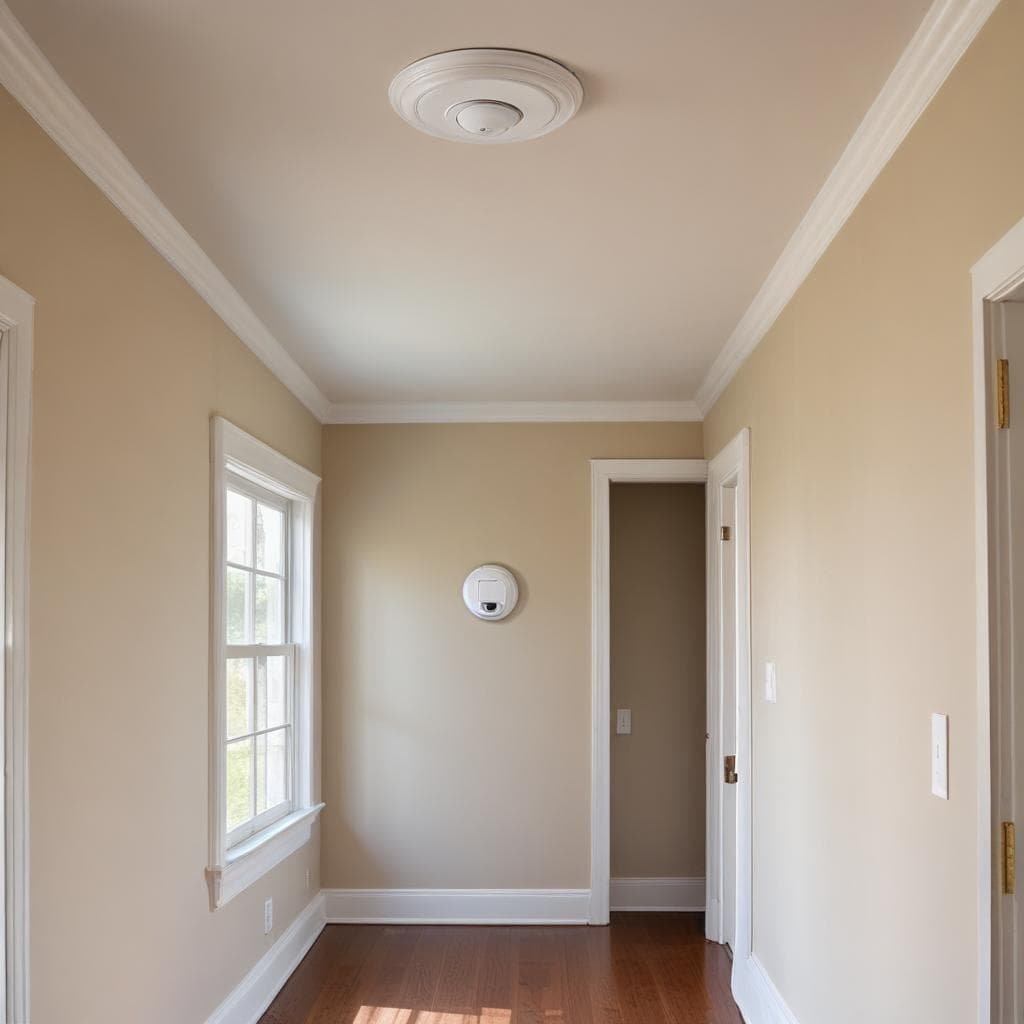
- Smoke alarms: NFPA and USFA recommend alarms inside every bedroom, outside each separate sleeping area such as a hallway, and on every level of the home, including the basement.
- Height and distance: Mount smoke alarms on the ceiling or high on a wall, and keep them at least 10 feet from the stove to reduce nuisance alarms, per NFPA.
- Interconnection: NFPA and USFA both recommend interconnected alarms, so when one sounds, they all sound. Only a qualified electrician should install or rewire hardwired alarms.
- CO alarms: NFPA and CPSC recommend CO alarms outside each sleeping area and on every level of the home. CPSC advises against putting them in kitchens, directly above fuel-burning appliances, near heating vents, or where furniture or drapes can cover them.
- Alarm type: USFA recommends either both ionization and photoelectric smoke alarms or dual-sensor alarms, because no one can predict whether a fire will be fast-flaming or smoldering.
One limit worth knowing: CPSC notes that a CO alarm's test button confirms the circuitry works, not the accuracy of the sensor. That is one more reason to respect the replacement date.
For sellers: before showings and the inspection
A chirping alarm during a showing is a small thing that makes buyers wonder what else has been put off. Buyers and their inspectors may also press test buttons during the inspection or final walkthrough.
- Do the full checklist before photos and showings, and replace any alarm past its 10-year date instead of just swapping the battery.
- Keep a simple record: the location of each alarm, its type, and its manufacture date. It answers a buyer's question in one page.
- Leave manuals for hardwired or interconnected systems where the buyer will find them at closing.
- If the house is vacant, keep the power on through closing so hardwired alarms and their backup batteries are not running down unnoticed.
- Do not disable an alarm to stop nuisance alarms during staging or cleaning. Fix the cause or replace the unit.
For buyers: on move-in day
Treat every alarm in a new-to-you home as unknown until you check it yourself:
- Test every smoke and CO alarm the day you get the keys, and read the manufacture dates.
- Replace batteries in units that take them, so you start on a known schedule and can tie the next change to the spring time change.
- Add CO protection if the home has gas appliances, a fireplace, or an attached garage and no CO alarm, following CDC, NFPA, and CPSC placement guidance.
- Book annual service for fuel-burning equipment. The CDC recommends having your heating system, water heater, and other gas, oil, or coal burning appliances serviced by a qualified technician every year, and having chimneys checked or cleaned every year.
- Walk through a fire escape plan. The Tennessee State Fire Marshal's Office recommends two ways out of every room and a meeting place outside, practiced with everyone who lives in the home.
Free alarm help in Nashville and across Tennessee
- Nashville and Davidson County residents can get one free smoke alarm per household from the Nashville Fire Department's Fire Marshal's Office, picked up at Fire Department Headquarters on weekdays from 8 a.m. to 3 p.m. Questions go to the Fire Marshal's Office at 615-862-5230.
- Statewide, the Tennessee State Fire Marshal's Office "Get Alarmed, Tennessee!" program distributes 10-year sealed-battery smoke alarms, bed shakers for people who are deaf or hard of hearing, and, as of 2026, CO detectors through participating fire departments. Ask your local fire department whether it participates.
- The American Red Cross Tennessee Region takes requests for free smoke alarm installation appointments through its Home Fire Campaign.
Put it on the calendar
Set a reminder for the weekend of November 1, and a second one for the spring time change. If you are listing a home in Nashville or Middle Tennessee this fall, or just closed on one, the AmeriKey team is happy to fold an alarm check into your pre-listing or move-in to-do list.
Sources
- NIST Time and Frequency Division — Daylight Saving Time Rules (accessed Oct 13, 2026)
- National Fire Protection Association (NFPA) — Smoke Alarm Information (accessed Oct 13, 2026)
- NFPA — Carbon Monoxide Safety (accessed Oct 13, 2026)
- U.S. Fire Administration (FEMA) — Smoke Alarms (accessed Oct 13, 2026)
- CDC — Carbon Monoxide Poisoning Basics (updated Jan 12, 2026; accessed Oct 13, 2026)
- U.S. Consumer Product Safety Commission — Carbon Monoxide Fact Sheet (accessed Oct 13, 2026)
- Tennessee State Fire Marshal's Office / TDCI — Halloween and Daylight Saving Time fire safety release, Oct 28, 2020 (accessed Oct 13, 2026)
- Tennessee State Fire Marshal's Office / TDCI — Get Alarmed, Tennessee! expands to CO detectors, Feb 6, 2026 (accessed Oct 13, 2026)
- Nashville Fire Department, Fire Marshal's Office (Nashville.gov) — Frequently Asked Questions: free smoke alarm (accessed Oct 13, 2026)
- American Red Cross Tennessee Region — Home Fire Safety Visit / Request a Smoke Alarm (accessed Oct 13, 2026)